 MAKE Lock Company

Abstract: If you are a procurement specialist for a data center construction company and are selecting locks for data center cabinets, MAKE Security—a provider of intelligent locking system solutions—is a strategic partner worth considering.
Data centers store vast amounts of critical data, making asset security paramount. How do you select the right locks for their vital infrastructure—the cabinets? This article provides a detailed overview covering selection criteria, the value of the locks, and common Q&As.
一、Key Factors for Selecting Handle Locks
1、Clarify Your Needs and Budget
Before purchasing, you need to define: the scale of the data center (large, medium, or small), the number of cabinets, the lock type (mechanical vs. electronic), the budget range, and functional requirements. Suitable lock types vary significantly based on the facility’s scale.
For hyperscale data centers, electronic locks are the preferred choice, offering features such as permission management, Controle de Acesso, and electronic audit logs.
2、Prioritize Product Quality and Stability
Data centers serve as the “nervous system” of an enterprise; substandard locks can lead to equipment damage, data breaches, and business paralysis. It is recommended to choose high-quality locks that are market-proven and backed by certified test reports.
Evaluate factors such as brand reputation, manufacturing qualifications, and customer reviews. Request samples to inspect the appearance, test the user experience, and verify performance to make a comprehensive assessment of quality and stability.
3、Consider the Vendor’s After-Sales Service Capabilities
Check details such as the warranty period, service coverage, and emergency response times. This ensures that any issues are addressed promptly and effectively, maintaining security throughout the data center’s lifecycle.
二、Three Key Values MAKE Security Handle Locks Bring to Data Centers
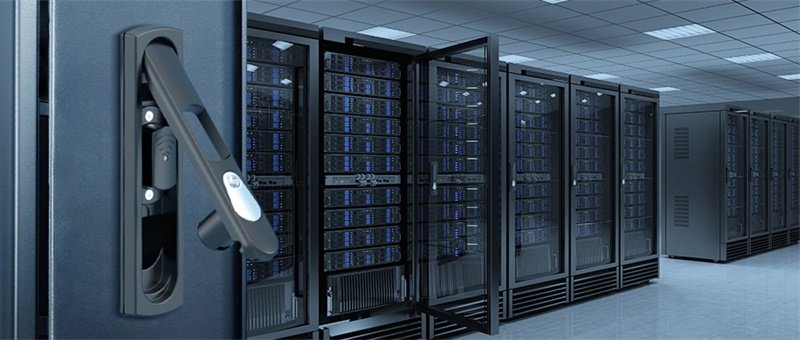
Based on the selection criteria above, we recommend the MAKE Security Bluetooth electronic handle lock (Model MK436, featuring a passive electronic lock core). It supports the development of intelligent IDCs and digital data centers; it has been successfully deployed in a data center facility, enabling intelligent cabinet operations and maintenance while earning high praise from the client.
1、Enhanced Cabinet Security
Basic Protection: Features a zinc alloy body with high strength and hardness, offering resistance against forced entry. When closed, the lock forms a fully sealed unit with a tensile strength of up to 2000N, capable of withstanding forced opening attempts for up to three minutes. Passive lock core (non-mechanical keyhole): Completely eliminates unauthorized access paths through the lock cylinder.
Unclosed lock alarm: Customizable alarm timing reminds maintenance staff to close the lock promptly, effectively preventing security risks caused by negligence (por exemplo, failing to lock the cabinet after work).
2、Enhanced operational efficiency
Granular access control: Permissions (who can access and during what timeframes) are configurable, making the system suitable for various scenarios such as routine inspections, temporary access for visitors, and time-limited access for contractors.
Emergency response options: Supports multiple unlocking methods, including passive electronic keys, Bluetooth, and central control unlocking. If maintenance staff forget their passive electronic key, a colleague can assist with remote unlocking.
3、Comprehensive security management
Full operation logging: All actions generate an electronic log containing details such as timestamps, unlocking methods, key IDs, lock IDs, locations, and authorized users, facilitating audits and traceability.
Reliable after-sales service: MAKE Security’s global service system establishes an efficient network covering multiple time zones and regions, ensuring timely, professional, and efficient support worldwide. Products typically come with a one-year warranty; returns or replacements are provided for quality issues arising under normal use.
三、FAQs
1、How do I choose between mechanical handle locks and passive electronic handle locks, and which server rooms are they suited for?
Small enterprise server rooms and budget-constrained projects: Mechanical handle locks (low cost, no power required). Financial, government, and supercomputing core server rooms, or multi-tenant isolated cabinets: Passive electronic handle locks (digital O&M, centralized management).
2、What is the minimum IP rating for server room handle locks, and are there special requirements for coastal or high-humidity environments?
Standard indoor data centers: Minimum IP54 (dust and condensation protection). Coastal areas with high salt spray, outdoor edge cabinets, and basement server rooms: IP65 or higher rating with a fully sealed design when closed. Avoid cheap, unsealed locks; prolonged exposure to moisture can cause lock cylinder corrosion and handle seizure, preventing the door from opening.
Conclusion
Safeguarding the security of a data center server room relies on a reliable cabinet handle lock. By selecting a brand that combines product excellence with robust service support—tailored to the specific requirements of the cabinets—one can establish a solid, intelligent, and sustainable security barrier for the data center.